
Types of Abuse: Understanding the Many Forms of Power and Control
Abuse does not always leave visible bruises. Types of abuse can include physical violence, emotional manipulation, psychological abuse, financial control, sexual abuse, verbal abuse, social isolation, and other behaviors used to gain power or control in a relationship. Understanding these patterns can be an important first step toward recognizing what you are experiencing and seeking appropriate support.
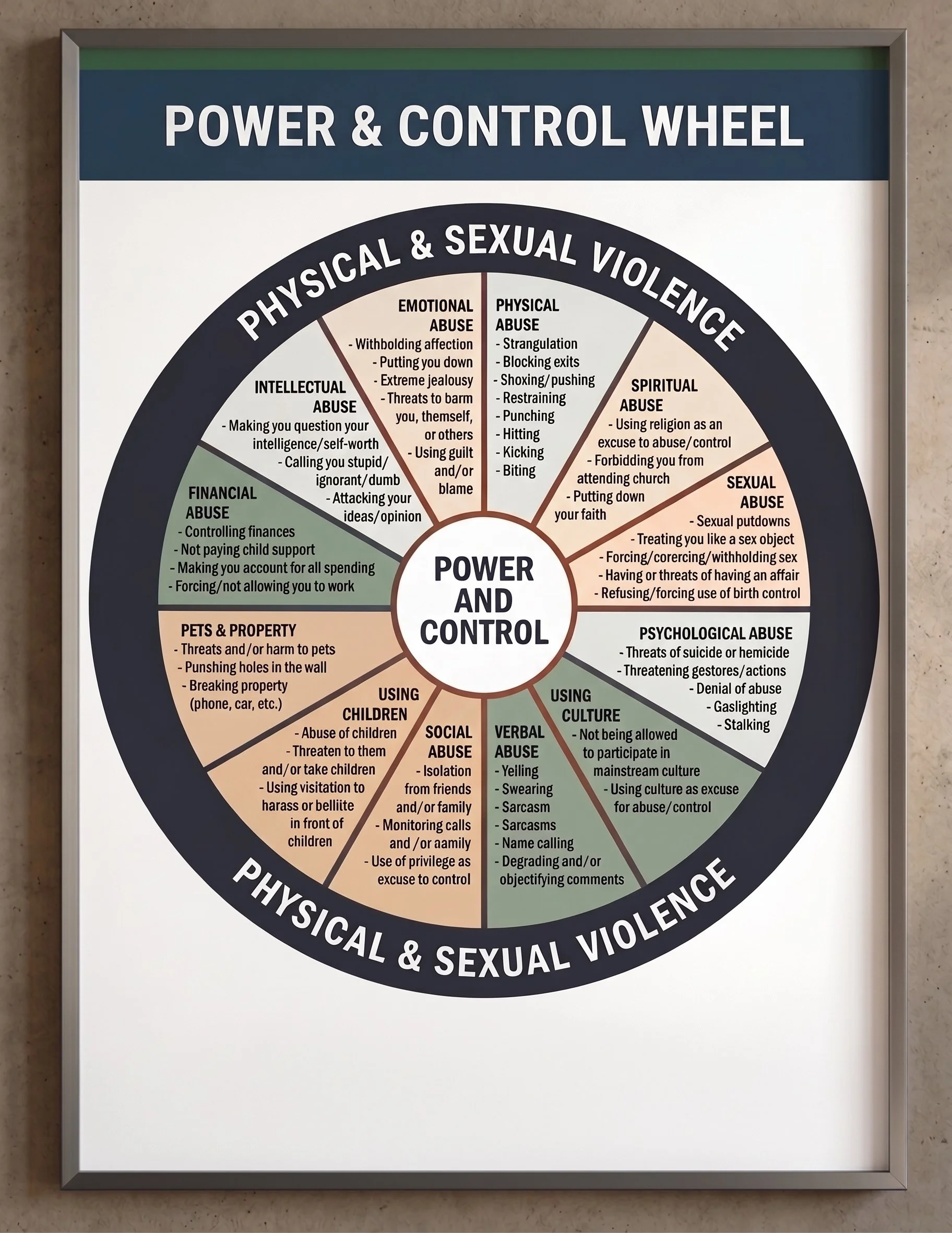
The Power and Control Wheel, developed through the Domestic Abuse Intervention Project and widely used in domestic violence education, illustrates how different forms of abuse can work together. The wheel places power and control at the center and identifies behaviors such as emotional abuse, intimidation, isolation, financial abuse, using children, threats involving pets or property, and other forms of coercive behavior.
It is also important to remember that abuse does not have to fit neatly into one category. Different forms of abuse can overlap, and each person's experience is different.

What Are the Different Types of Abuse?
There are many types of abuse, and some are easier to recognize than others.
Physical violence may be the most commonly recognized form, but abuse can also affect a person's emotional well-being, finances, relationships, spirituality, sexuality, sense of identity, and ability to make independent choices.
The following types of abuse can occur individually or together.
1. Physical Abuse
Physical abuse involves using physical force to hurt, intimidate, restrain, or control another person.
Examples may include:
Hitting or punching
Kicking
Slapping
Pushing or shoving
Biting
Restraining someone
Blocking a person's exit
Throwing objects
Using physical intimidation
Strangulation or choking
Physical abuse does not need to happen frequently to be serious.
A person may also use physical intimidation without directly striking someone. For example, blocking a doorway, punching a wall, destroying belongings, or standing over someone during an argument may create fear and communicate a threat.
2. Emotional Abuse
Emotional abuse involves behaviors that repeatedly undermine a person's emotional well-being, confidence, or sense of security.
Examples may include:
Putting someone down
Withholding affection as punishment
Extreme jealousy
Constant criticism
Threatening to harm themselves or someone else
Using guilt to control behavior
Blaming the other person for their actions
Making someone feel responsible for another person's emotions
Humiliating or degrading someone
Emotional abuse can be difficult to recognize because there may be no physical evidence.
Over time, a person may begin questioning their own worth or wondering whether they are responsible for keeping the relationship peaceful.
3. Psychological Abuse
Psychological abuse can involve behaviors intended to create fear, confusion, insecurity, or emotional dependence.
Examples can include:
Threats
Intimidation
Gaslighting
Denial of abusive behavior
Threatening suicide or homicide
Stalking
Threatening gestures or actions
Deliberately creating fear
Gaslighting is one form of psychological manipulation that can cause a person to question their memory, perceptions, or understanding of events.
Someone experiencing psychological abuse may eventually begin thinking:
"Maybe I'm remembering it wrong."
"Maybe I'm overreacting."
"Maybe this really is my fault."
Repeated manipulation can make it increasingly difficult to trust your own judgment.
4. Verbal Abuse
Verbal abuse uses spoken or written words to demean, intimidate, threaten, or control another person.
Examples include:
Yelling
Swearing
Name-calling
Insults
Sarcasm used to humiliate
Put-downs
Threats
Degrading comments
Objectifying language
Not every disagreement or raised voice is verbal abuse.
The larger pattern matters.
Healthy relationships can include frustration and conflict. Abuse involves patterns of behavior that are used to intimidate, demean, control, or create fear.
5. Sexual Abuse
Sexual abuse occurs when someone uses sexual behavior, pressure, coercion, or threats without freely given consent.
Examples may include:
Forcing or pressuring someone to have sex
Withholding sex as punishment
Treating someone as a sexual object
Sexual threats
Sexual put-downs
Reproductive coercion
Forcing or controlling birth control
Threatening to have an affair
Sexual contact without consent
Consent is important in every relationship.
Being married, dating, or having had consensual sex in the past does not mean someone is automatically entitled to sexual contact in the future.
A person has the right to change their mind and communicate what they are or are not comfortable with.
6. Financial Abuse
Financial abuse, sometimes called economic abuse, involves controlling another person's access to money, employment, financial information, or economic resources.
Examples can include:
Controlling household finances
Monitoring every purchase
Preventing someone from working
Forcing someone to account for all spending
Taking someone's money
Preventing access to bank accounts
Refusing to contribute to necessary expenses
Using money to punish or control
Creating financial dependence
Financial abuse can make leaving an unhealthy or abusive relationship much more difficult.
A person may know that a relationship is unsafe but feel trapped because they do not have independent access to money, housing, transportation, or other resources.
7. Social Abuse and Isolation
Social abuse involves controlling someone's access to friends, family, coworkers, community, or other sources of support.
Examples may include:
Preventing someone from seeing friends
Discouraging contact with family
Monitoring phone calls
Monitoring emails or messages
Creating conflict between someone and their support system
Controlling where someone goes
Making it difficult to participate in activities
Using jealousy to restrict relationships
Isolation can increase a person's dependence on an abusive partner.
When someone is separated from the people who know and support them, it can also become harder to recognize that what they are experiencing is not healthy.
8. Spiritual or Religious Abuse
Spiritual abuse involves using religion, faith, or spiritual beliefs as a way to control, shame, or manipulate another person.
Examples may include:
Using religion to justify abuse
Preventing someone from attending religious services
Using religious beliefs to shame someone
Telling someone they must stay in a relationship because of their faith
Using religious authority to control decisions
Putting down someone's faith or spiritual beliefs
Faith can be a meaningful source of strength and support for many people.
Abuse occurs when beliefs or religious practices are used as tools of coercion, fear, or control.
At Anchor of Peace, faith can also be incorporated into therapy when it is important to the client. The practice describes its approach as integrating Christian values with evidence-based psychological care when clients want that support. (Anchor of Peace)
9. Intellectual Abuse
Intellectual abuse involves attacking or undermining someone's intelligence, opinions, education, or ability to think for themselves.
Examples may include:
Calling someone stupid or ignorant
Mocking someone's opinions
Constantly correcting or belittling them
Making someone question their intelligence
Dismissing their ideas
Using knowledge or education to intimidate
Acting as though the other person is incapable of making decisions
Over time, this type of behavior can contribute to self-doubt.
You may begin avoiding conversations because you expect to be criticized or dismissed.
10. Abuse Involving Children
Children can become part of an abusive dynamic in several ways.
Examples may include:
Threatening to take the children away
Using visitation as a way to harass or intimidate
Threatening harm to the children
Using children to communicate with the other parent
Putting children in the middle of adult conflict
Using children to monitor the other parent
Undermining the other parent's relationship with the children
Children may also be directly exposed to abusive behavior even when they are not physically harmed themselves.
If children are involved in an abusive situation, individualized professional and safety support can be especially important.
11. Abuse Involving Pets and Property
Pets and personal belongings can also be used as tools of intimidation and control.
Examples may include:
Threatening to hurt a pet
Hurting an animal
Threatening to give a pet away
Destroying sentimental belongings
Breaking phones or computers
Damaging vehicles
Punching holes in walls
Destroying household property
These behaviors can communicate a threat even when the person is not directly physically attacked.
For someone who loves their pet deeply, threats toward an animal can create significant fear and emotional distress.
12. Cultural Abuse
Cultural abuse can involve using a person's culture, identity, traditions, or community expectations to control or shame them.
Examples may include:
Using cultural expectations to justify controlling behavior
Preventing participation in cultural or community activities
Using someone's cultural identity against them
Threatening social rejection
Using cultural beliefs as an excuse for abuse
Preventing someone from maintaining important cultural connections
Culture can be an important part of a person's identity and support system. It should not be used as a tool to take away someone's autonomy.
Abuse Is Often About a Pattern of Power and Control
One reason the Power and Control Wheel can be helpful is that it shows how different behaviors can connect.
Physical violence may be only one part of an abusive relationship.
Someone might experience emotional abuse, financial control, isolation, intimidation, and sexual coercion without experiencing physical violence.
Another person may experience several types of abuse at once.
The important question is not simply:
"Was I physically hurt?"
It can also be helpful to ask:
"Do I feel free to make my own choices?"
"Can I say no without being afraid?"
"Can I maintain relationships with people I care about?"
"Do I feel safe expressing my opinions?"
"Am I constantly trying to prevent someone else's anger?"
"Do I feel like I have to walk on eggshells?"
These questions may help you notice patterns that are difficult to identify when you are living inside them.
Why It Can Be Difficult to Recognize Abuse
Abuse does not always begin with obvious behavior.
A relationship may begin with affection, attention, and connection.
Controlling behaviors may develop gradually.
For example, jealousy may initially be presented as caring. Checking your phone may be described as wanting reassurance. Isolation may be presented as wanting more time together.
Over time, these behaviors can become increasingly restrictive.
This is one reason it can be difficult to identify abuse while it is happening.
You may also have been told that you are the problem or that the behavior is your fault.
Seeking support does not require you to have everything figured out first.
How Therapy Can Help After Abuse
Therapy cannot make decisions for you, and it should not pressure you into making a particular relationship decision.
Instead, therapy can provide a space to understand your experiences and reconnect with your own needs, values, boundaries, and sense of self.
At Anchor of Peace, therapy focuses on relationship anxiety, boundaries, trust and attachment healing, and self-confidence and emotional empowerment. (Anchor of Peace)
Therapy may help you:
Rebuild self-trust
Strengthen healthy boundaries
Reduce relationship anxiety
Process past relational experiences
Understand unhealthy relationship patterns
Practice assertive communication
Develop emotional regulation skills
Reconnect with your needs and values
Build confidence in your decisions
Explore what emotionally safe relationships look like
Healing is not about becoming someone you were not.
It can be about reconnecting with the person you were before you learned to silence yourself, overgive, or constantly monitor another person's reactions.
If You Recognize Yourself in These Types of Abuse
You do not need to decide immediately what your next step should be.
You can start by talking with someone you trust.
A therapist, domestic violence advocate, or other qualified professional can help you understand your options and identify resources that fit your circumstances.
If you are currently experiencing abuse, consider your personal safety when seeking help. If someone monitors your phone, computer, browser history, email, or location, accessing information about abuse or therapy may need to be done from a safer device or location.
If you are in immediate danger, call 911.
For confidential domestic violence support and safety planning in the United States, you can contact the National Domestic Violence Hotline at 800-799-SAFE (7233) or text START to 88788.
You Deserve Relationships Where You Can Be Yourself
Understanding the different types of abuse can help put words to experiences that may have felt confusing for a long time.
Abuse can be physical.
It can be emotional.
It can be sexual.
It can be financial.
It can be psychological, verbal, spiritual, social, intellectual, or cultural.
It can involve children, pets, or property.
And sometimes several forms happen at the same time.
If you have spent a long time questioning yourself, walking on eggshells, or putting someone else's needs ahead of your own to avoid conflict, therapy can provide a place to begin reconnecting with your voice and your boundaries.
At Anchor of Peace, Kristina Carrera, LCSW, LAC, DVCS, works with adults experiencing relationship anxiety, trust challenges, boundary struggles, and relational wounds. Her approach is collaborative, practical, and compassionate, with a focus on helping clients build self-trust, emotional safety, and healthier relationships. (Anchor of Peace). Anchor of Peace offers online therapy throughout Colorado, including Colorado Springs, Denver, Pueblo, Boulder, and Fort Collins, with in-person services available in Pueblo.
If you are ready to talk with someone about what you have experienced, you can schedule a free 15-minute consultation with Anchor of Peace to ask questions and determine whether therapy feels like the right next step for you.
Frequently Asked Questions About Types of Abuse
-
Common forms include physical, emotional, psychological, verbal, sexual, financial, social, spiritual, intellectual, and cultural abuse. Abuse may also involve children, pets, property, or other forms of intimidation and control.
-
Yes. Emotional abuse can involve repeated behaviors intended to demean, intimidate, manipulate, isolate, or undermine another person's emotional well-being.
-
Yes. Physical violence is not required for a relationship to involve abuse. Controlling, threatening, coercive, sexual, financial, emotional, psychological, and other abusive behaviors can occur without physical assault.
-
Conflict can occur in healthy relationships. Abuse involves patterns of behavior used to control, intimidate, demean, threaten, or restrict another person's autonomy and safety.
-
Therapy can provide support for processing relational experiences, rebuilding self-trust, developing boundaries, managing anxiety, and understanding relationship patterns. The appropriate approach depends on the individual's circumstances and goals.
