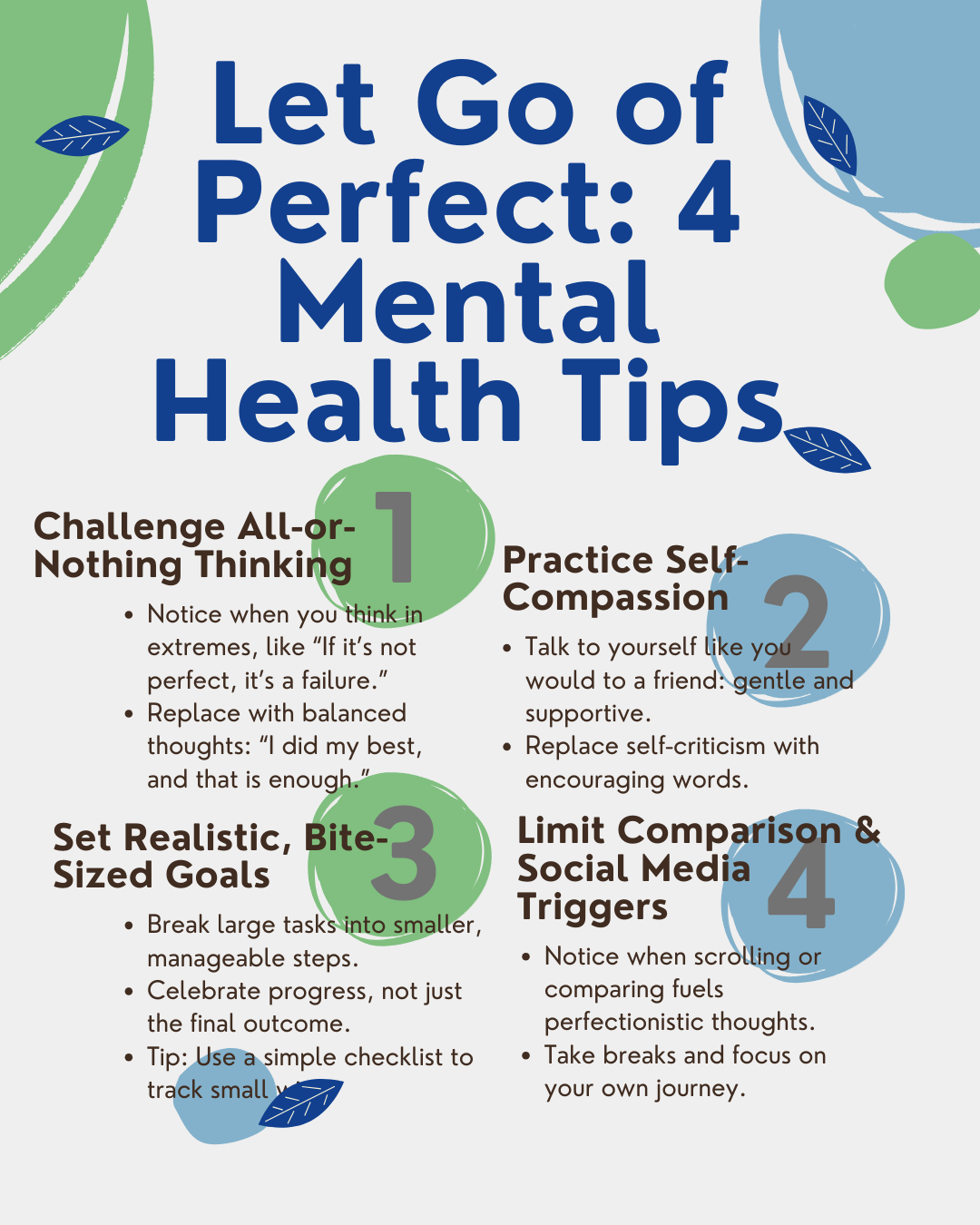
Let Go of Perfect: 4 Mental Health Tips to Ease Perfectionism
Perfectionism can feel like a heavy weight, whether it shows up at work, school, or in your personal life. I remember a time when I spent countless hours perfecting a work presentation, only to receive feedback that it was 'good enough' hours after my self-imposed deadline had passed. I realized then that chasing perfection often left me exhausted and anxious, detracting from my overall well-being. It's important to understand that setbacks are a normal part of the process and don't define your journey. Progress isn’t always linear; embracing this can reduce self-criticism. You don’t have to give up your goals; instead, try shifting your focus from perfect results to steady self-kindness and growth. Here are four gentle tips to help you break free from all-or-nothing thinking and support your well-being.

1. Challenge All-or-Nothing Thinking
If you struggle with perfectionism, you might notice your mind jumping to extremes; everything has to be perfect, or it feels like a failure. This can add to your stress and self-doubt. When you catch these thoughts, pause and gently remind yourself of a more balanced truth. For example, swap "If it’s not perfect, I’ve failed" for "I did my best, and that is enough." Additionally, change "I have to be the best at this" to "I am allowed to learn and improve along the way," or "Everyone else is better than me" to "Everyone is on their own unique journey, including me." To embody this shift, try a short self-compassion exercise: place a hand on your heart and, while taking a deep breath, repeat the balanced truth aloud. With practice, this shift can bring more calm and healthier habits.

2. Practice Self-Compassion
Try practicing self-compassion. If you tend to be hard on yourself for mistakes, imagine how you’d talk to a friend in the same situation. Offer yourself the same gentle support. Instead of self-criticism, encourage yourself with words like, “It’s okay to make mistakes,” or “I’m learning and growing.” This simple shift can build your resilience and quiet that inner critic.

3. Set Realistic, Bite-Sized Goals
Big tasks can feel overwhelming and may trigger perfectionism. Try breaking projects into smaller, manageable steps so progress feels possible. Create a checklist to track your small wins and celebrate each milestone along the way, not just the finish line. Use reminders, such as sticky notes or digital prompts, to keep breaking tasks down and to celebrate progress at the forefront of your mind. Anchor each small victory with a simple, rewarding ritual, like doing a quick stretch or playing a favorite song. This not only acknowledges your progress but also reinforces the habit of noticing and valuing these little victories, which can ease anxiety and help you stay motivated.

4. Limit Comparison and Social Media
Empirical research has demonstrated that the use of social media platforms can exacerbate perfectionistic tendencies, largely due to the prevalence of curated and idealized representations of others' lives (Fardouly et al., 2015). For example, individuals who frequently engage with social media content often report heightened levels of self-comparison, which can perpetuate feelings of inadequacy and a compulsion to meet unrealistic standards. If you become aware of engaging in such comparisons—for instance, noticing distress after viewing images of peers' achievements or lifestyles—acknowledging these emotional responses is vital. Allow yourself to disengage from these platforms when necessary, and intentionally redirect your attention to your personal development and individual aspirations. Establishing and maintaining clear boundaries regarding social media usage, such as limiting screen time or unfollowing content that triggers negative self-evaluation, has been shown to support psychological well-being and mitigate the negative impact of perfectionistic comparisons.

Final Thoughts
The process of relinquishing perfectionism represents an ongoing developmental trajectory in which psychological well-being remains paramount. Engaging with strategies such as challenging dichotomous thinking, cultivating self-compassion, establishing attainable objectives, and minimizing social comparison facilitates sustained cognitive and emotional change. Central to this process is the recognition that meaningful advancement is predicated on consistent incremental growth rather than unattainable standards of flawlessness. Systematic self-reflection, such as implementing a structured 'imperfection check-in' at the end of each day, invites a deeper appraisal of personal progress and supports the integration of rest as a necessary component of resilience and self-care. Importantly, seeking interpersonal support—through dialogue with empathetic peers, participation in support groups, or engagement with mental health professionals—constitutes an adaptive coping strategy that enhances both insight and motivation. Ultimately, embracing restorative practices and intentionally acknowledging one’s efforts contribute to a more sustainable and psychologically adaptive model of personal achievement.